


There was once a football club. It had history, pride, and a bunch of guys who knew how to kick a ball. They had their routines, their beers after practice, and a way of playing that was like a well-worn jacket—comfortable and reliable.

Then came the new manager. The management brought him in with promises of glory, but everyone knew him as a rigid, inflexible individual with a severe demeanor. Nobody welcomed him. Nobody wanted him. He was dreaded like a Monday morning hangover.

This guy hit the ground running. Changed everything. Training became a nightmare. Long hours, relentless drills. He wanted them to run like machines, think like soldiers. The easy camaraderie in the locker room turned into a tense silence. Some of the old-timers couldn’t take it. They either got benched or left. It was a massacre of familiarity.
The games were brutal. They lost more often than they won. The fans, who used to cheer them on, started to boo. But the manager didn’t care. He pushed harder. The few who stuck around either adapted or got out.
Bit by bit, things started to change. The team, those who survived the culling, got tougher. They ran faster, played harder. They started winning. It wasn’t pretty, but it was effective. By the end of the season, they were a different beast altogether—leaner, meaner, and somehow, stronger.
This rough ride of a soccer team is a lot like what happened to a lot of businesses, including the logistics industry during the COVID-19 pandemic. It was a black swan event that turned everything upside down. Borders closed, supply chains snapped like old rubber bands. The industry was thrown into chaos. COVID-19 brought destruction in ways that were not replaceable. Lives lost, businesses shuttered for good. It was unfortunate and starkly tragic.
Businesses, like the old soccer players, faced low demand, fear, lockdowns.
As if the pandemic wasn’t enough, the Russia-Ukraine war and the Red Sea crisis slammed into the industry like a freight train. Shipments were delayed, routes were blocked, and costs soared. The sector had to twist and turn, taking hits and adjusting on the fly, just to keep things moving.
In any industry, there’s an unwritten rule: disruption is always lurking, shaking up how businesses think about tech, operate, and plan for the future.
Who remembers the chip shortage era just a couple of years back? How did it disrupt the global supply chain? So many businesses / customers suffered due to this disruption. Isn’t it?

It was a wake-up call, showing just how crucial supply chain management is and why businesses should never take it for granted.
Market trends do hit hard. A lot of disruption within disruption happened though.
And the logistics and supply chain itself is no different.
We know how people started shopping online like never before due to the impact of the pandemic. Digital Commerce 360 said online grocery sales in the U.S. shot up by 103% in 2020. UN experts noted that global e-commerce sales jumped from 16% to 19% in 2020. The demand was insane.
Basically, the logistics and supply chain industry had to scramble. They had to reinvent themselves or die trying. They adopted automation, optimized inventory, tracked orders better, upgraded supply chain tech, and nailed last-mile delivery.
The ones who adapted, survived. The rest fell by the wayside.

But today despite supply chain management and logistics being the backbone of any business, they remain unsung heroes behind the scenes. They’re the ones that keep the wheels turning. SCM is all about getting goods and services flowing smoothly, transforming raw materials into finished products. It slashes excess costs and speeds up delivery to the customer.
Good SCM? It’s the difference between smooth sailing and a disastrous shipwreck. It can prevent costly product recalls, lawsuits, and the kind of bad publicity that can sink a company.

Thank god, Apple survived. 😛
The five critical phases—planning, sourcing of raw materials as well as spares, production, distribution, and handling returns/aftermarket management—are like the gears in a well-oiled machine.
Globalization has only turned up the heat. Now, materials and products crisscross the globe, adding layers of complexity. The stakes are higher, the risks greater. One hiccup in a distant port can send ripples through the entire chain. But with superior SCM and logistics, businesses can turn potential global disruptions or chaos into opportunities.
SCM and logistics in today’s connected world are the ones who keep businesses afloat, unsung and unappreciated, but absolutely essential.
Similarly, as investors it’s strange that no one seems to be bothered looking at the supply chain solutions providers in this rapidly evolving bull-market – which is harping on one sector to the other just like the Road Fighter changing lanes at full throttle.

Is this sector the next turbocharged engine (the colorful car) that boosts the road fighter? Time will tell. What we do know is that it’s one of the most overlooked and misunderstood industries.
That’s why we’ve decided to dive deep into this field—simplify the complexities and figure out where it’s headed. In this blog we will cover the following:
- The Supply-Chain Solutions / Logistics Industry – A Primer
- The Moat in Integrated Supply Chain Solutions (ISCS) Sector
- The Landscape of the industry in India
Before, we go ahead, if you like such long form posts you can subscribe to our newsletters here:


The Supply-Chain Solutions / Logistics Industry – A Primer
It is clear that Logistics is a critical element of economic activity, facilitating trade within and outside the country. Before we get into the meat of the matter, let us first understand certain important terms.
On the surface, logistics is nothing but transporting goods from point -A to point-B. Simple.
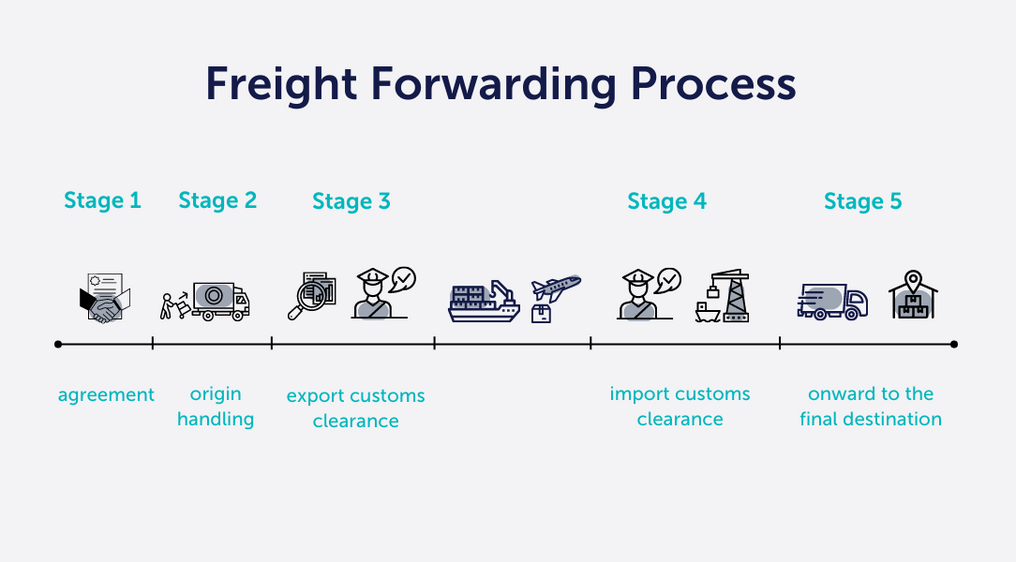
And if we’re talking about a business, this is how it broadly looks like for any typical consignment :

Source: Hemisphere Freight
Some terms:
Freight
Imagine you want to send your toy car to your friend who lives far away. Freight is the money you pay to the people who help move your toy car from your place to your friend’s place, whether it’s by truck, train, or airplane.
Clearing
When your toy car crosses the border to another country, it needs permission from the people in charge there (like customs officers). Clearing is the process of getting that permission so your toy car can enter the new country.
Forwarding
Forwarding is like having a helper who knows the best way to send your toy car to your friend. This helper arranges everything – from picking up your toy car to finding the best route and making sure it gets delivered safely.
Handling Charges
Handling charges are like a fee you pay to the people who take extra care of your toy car. They might pack it nicely, load it onto a truck, or unload it at the destination to make sure it doesn’t get damaged.
Hope this is clear.
But hey, it is usually not as linear and easy as it looks. Especially for large businesses.
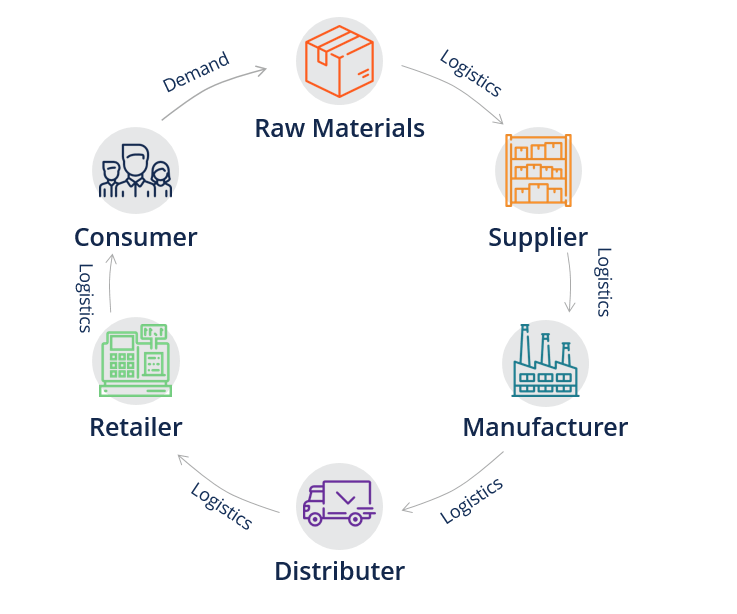
The management of the flow of goods and services, involving the movement and storage of raw materials, work-in-process inventory, and finished goods from point of origin to point of consumption – or simply the entire supply chain – is highly critical and is referred to as Supply Chain Management.

Source: CFI
Now ,let us picture how this entire Integrated Supply Chain Service thing works.
Supply chain solutions are like teamwork. Instead of just one person doing everything, at least two different helpers work together to get things done. Here is how a typical supply chain structure looks like:

Let us understand certain components of the Supply Chain in brief with the help of an example:
- Inbound Logistics (Sourcing & PO Management):
- Example: Jaguar Land Rover requires various components to build their vehicles. Suppliers 1, 2, and 3 could be manufacturers of engines, transmission systems, and electronic modules. A RFQ is placed to these manufacturers. The one best suited in terms of cost, delivery time and technicalities is selected. It is then transported from the manufacturers’ warehouse to Jaguar Land Rover’s raw material warehouses.
- Inbound logistics via air/sea/rail/road.
- Inbound Transportation:
- Example: Once the parts are ready from the suppliers, they are transported to Jaguar Land Rover’s manufacturing plant or warehouses. This stage ensures that all necessary materials are available for vehicle assembly.
- In-Plant Logistics (Integrated Transportation Management):
- Example: After Jaguar Land Rover receives various components (like engines, transmission systems, and electronic modules) from its suppliers, these parts are transported to the manufacturing plant.
- At the plant, these components undergo value addition. This means they are assembled into a final product, such as a car. This stage involves multiple processes like welding, painting, assembly of different parts, and quality checks.
- During the assembly process, there are intermediate stages where the partially assembled vehicles, or work-in-progress (WIP) goods, need to be stored temporarily. These WIP goods are stored in the factory warehouse.
- Outbound Logistics (Freight Forwarding):
- Example: Once the vehicles are fully assembled and have passed all quality checks, they are moved out of the plant. They are then transported to distribution centers or directly to dealerships, where they eventually reach the end customers.
- Outbound Logistics (Last-Mile Delivery):
- Example: The final products, such as new cars, are transported from the secondary warehouses directly to dealerships or to consumers. This stage includes last-mile delivery, ensuring timely and efficient delivery of the vehicles to the end consumers.
- Reverse Logistics or Aftermarket (Spare Parts Fulfillment & Returns, Break-Fix Support):
- Example: If a customer’s car has an issue, Jaguar Land Rover offers reverse logistics services. Defective parts are returned, and spare parts are fulfilled to repair the vehicles. Break-fix support ensures that any malfunctioning products are fixed promptly, maintaining customer satisfaction.
Businesses today are grappling with challenges related to sourcing raw materials, storage and inventory management, spare part logistics, and analyzing data to optimize procurement and logistics solutions, as well as providing effective aftermarket support.
Today, it’s not just about moving goods—it’s the quiet force that keeps the global economy in motion, stitching together supply chains and ensuring the gears of commerce turn smoothly.
As mentioned before, in today’s digital age, the supply chain ain’t just a straight line anymore. It’s a tangled web, a maze of digital threads and countless players.
Businesses today don’t just have to deal with suppliers and customers—they also have to juggle a circus of partners, all in the ring together. Be it procurement/sourcing or warehousing/storage or in-bound and out-bound transportation to deliver it to the client/retailer and handling the return/repair of their products – it’s erm…overwhelming sometimes for these businesses.
And out of this chaos, we’re seeing a rise of integrated service providers who play a pivotal role in orchestrating seamless operations from start to finish, ensuring everything flows smoothly.
Anyhow. More on it later. First, let’s try to understand this space better. We break the logistics sector into two major categories:
- By Type of Services

- By Type of Solutions. Here we have also tried to show its evolution over time.

Now 1PL and 2PL were either handled by the company themselves or via middleman and only involved Transportation. 2PL is highly fragmented and is usually a monoline service with minimum margins.
But let us talk about the players who handle complicated stuff and understand how they operate because remember more the complexity handled – more the margins.
- Third-Party Logistics (3PL) Solution Providers
3PL providers offer outsourced logistics services, which typically include transportation, warehousing, inventory management, order fulfillment, and sometimes value-added services like packaging and assembly. They act as intermediaries between the company and the end customers, handling the logistics operations but not taking ownership of the goods.
Example: A company that sells electronics, like a laptop manufacturer, may use a 3PL provider to manage its logistics. The 3PL company would store the laptops in its warehouses, handle inventory management, pick and pack orders, and ship the laptops to customers. The laptop manufacturer benefits from the 3PL’s expertise and infrastructure without having to invest in its own logistics network.
- Fourth-Party Logistics (4PL) Solution Providers
4PL providers go a step further by managing the entire supply chain. They coordinate multiple 3PLs and other logistics services, providing a single point of contact for the client. A 4PL typically offers higher-level strategic management, overseeing everything from transportation and warehousing to IT solutions and consulting.
Example: A global retail chain may hire a 4PL provider to manage its entire supply chain. The 4PL provider will coordinate various 3PL companies for different regions, handle customs and compliance, manage suppliers, optimize logistics processes, and provide technology solutions for real-time tracking and data analytics. The retail chain benefits from a streamlined and optimized supply chain without the complexity of managing multiple logistics partners.
Summary
- 3PL: Focuses on specific logistics functions like transportation and warehousing. Example: A 3PL storing and shipping laptops for a manufacturer.
- 4PL: Manages the entire supply chain, coordinating various 3PLs and logistics services. Example: A 4PL overseeing the supply chain for a global retail chain, handling all logistics aspects and providing strategic management.
Post 2015, however, a niche segment in this entire value chain bloomed in which the operators provide complex end-to-end supply chain solutions to large companies. ISCS emphasizes integrated technology solutions and operational efficiencies across various supply chain functions, including system integration and optimization tools.
While 3PL and 4PL solution providers mainly cater to the in-bound and out-bound logistics (transportation and warehousing) on a standalone basis, ISCS providers emphasize on integrated technology solutions and operational efficiencies across various supply chain functions, including system integration and optimization tools.


Basically, if I had to further simplify -While 3PL and 4PL providers focus on specific logistics tasks (like transportation, warehousing, and supply chain management), ISCS providers offer strategic oversight and technology integration across the supply chain.
We believe this is where the next leg of growth in the logistics/supply chain industry is going to come from. And investors should be following it closely. Here’s why.
The Moat in Integrated Supply Chain Solutions (ISCS) Sector
As mentioned earlier, there are many companies in India which are into either transportation/delivery or just warehousing. This is handling just logistics, by the way. Their business models might differ -whether it be B2B or B2C, but this is how it can broadly be classified:

Source: PwC
However, Integrated Supply Chain Solutions providers are present across the value chain. They offer a range of services by integrating various sub-processes/components of the value chain, which then help in streamlining and optimizing various processes across the entire supply chain. And these are mainly tech and data enabled solutions.
System integration involves combining different subsystems, processes or components into one large system like a cog in the well-oiled wheel, to ensure they work together seamlessly. In the context of supply chain solutions, this often includes integrating various software and hardware systems to provide a cohesive and efficient operation.
Key aspects of ISCS include:
- They’re Across the Value Chain
Value chain refers to the entire series of steps that add value to a product or service, from its initial creation to its final delivery to the customer. Integrated supply chain solution providers enhance processes at each stage using technology and data, which can include:
- Procurement: Managing the acquisition of raw materials and components needed for production.
- Production: Streamlining manufacturing processes to improve efficiency and reduce costs.
- Warehousing: Efficiently storing goods and managing inventory levels.
- Transportation: Ensuring goods are transported in the most efficient and cost-effective manner.
- Distribution: Coordinating the delivery of finished products to end customers or retailers.
B. They Provide Value-Added Services
Value-added services are additional services that go beyond the standard logistics and transportation offerings, providing extra benefits to clients. These can include:
- Custom Packaging: Tailoring packaging solutions to meet specific product or customer requirements.
- Labeling and Relabeling: Ensuring products are correctly labeled for compliance and marketing purposes.
- Kitting and Assembly: Combining multiple products into kits or assembling components into finished goods.
- Reverse Logistics and Aftermarket: Managing the return of goods, including processing returns, refurbishing products, managing spares, providing spares to 3rd parties, and handling disposal.
- Cross-Docking: Directly transferring products from inbound to outbound transportation with minimal storage time, reducing handling and storage costs.
- Real-Time Tracking and Reporting: Providing customers with visibility into their supply chain through real-time tracking of shipments and detailed reporting on various metrics.
C. Here is how it benefits the businesses:
- Improved Efficiency: By integrating systems and processes, companies can reduce redundancies and streamline operations.
- Cost Savings: Efficient management of resources and optimized transportation routes lead to cost reductions.
- Enhanced Visibility: Real-time tracking and comprehensive reporting provide better oversight and control over the supply chain.
- Scalability: Integrated solutions can scale with the business, accommodating growth and changes in demand.
- Customer Satisfaction: Faster, more reliable deliveries and value-added services enhance customer experience.
Overall, integrated supply chain solution providers offer tech and data enabled comprehensive and cohesive services that enable businesses to operate more efficiently, reduce costs, and improve customer satisfaction by optimizing every aspect of the supply chain.
The ISCS market is highly organized and has significant barriers to entry due to the complex knowledge, strong relationship/trust with clients and capital requirements in the industry.
We’ve mentioned ‘tech and data enabled’ a lot here – right? Well, ISCS providers gain a competitive edge by harnessing extensive transaction and environmental data. They excel in collecting, organizing, storing, and analyzing this data, using advanced analytical capabilities to enrich customer solutions. This ability to leverage data for actionable insights is a crucial differentiator, enhancing operational efficiency and decision-making.
Moreover, ISCS providers utilize IoT systems to create interconnected logistics networks. Through advanced IoT sensors, they automate tracking and analysis of physical assets like equipment and inventory. This real-time visibility allows customers to optimize efficiency and streamline operations, further solidifying the ISCS providers’ competitive advantage in the market.
Currently in its early stages in the country, the ISCS market is anticipated to experience exponential growth in the coming years.
Here are the key trends in the market today:
- Growing recognition among industry players that supply chain efficiencies can provide a strategic advantage.
- The expansion of third-party logistics (3PL) companies, enabling them to offer comprehensive integrated logistics services.
- A rising demand for integrated logistics services as companies outsource operations to focus on their core competencies.
- An increasing emphasis on incorporating digital technology into the value chain, driving up the demand for integrated logistics solutions.
The Indian Logistics and Supply Chain Industry
The Indian logistics scene is shifting, and it’s shifting fast. Everyone wants data-backed, real-time visibility now. It’s the digital age, and enterprises are hungry for precision. Each bps of margin expansion is significant, especially for the large businesses. Plus, COVID changed things.
Now these businesses want their supply chains tight, efficient, and packed with value-added services. They’re dumping the single-service providers for big players who can offer the whole package – the entire gamut of supply chain solutions.
The Government too is doing its bit.
GST rolled out, and suddenly, the game changed. Companies are hunting for speed and efficiency, not just cost. They want it all from one reliable service provider. No more piecing together services from here and there. They want a total-cost approach, and they want it easy. Now there’s also an increasingly favorable policy support for developing supply chain services (for example, PM Gati Shakti, and National Logistics Policy (NLP).
Then there’s the rise of the Tier-2 and beyond towns. These places are booming with consumer demand, and enterprises can’t ignore them. They need logistics that can match urban centres in turnaround time and reliability, even if the roads are rough and the infrastructure is lacking.
Customers today, whether individuals or businesses, are becoming increasingly demanding. They want their products faster, and more importantly on their own terms. If they are consumers, they don’t want to pay for delivery, expect faster shipping, and require efficient return management and cash-on-delivery options. Getting around is difficult and requires expertise. Smart businesses are starting to take notice and have started to arm themselves accordingly.
Now, as we all know, the focus of the current government is to develop into a manufacturing hub. From Semiconductors and Electronics to Pharmaceuticals and Chemicals, there is clearly a spike in activity – either in terms of production or investment (for the future).
Moreover, there is an increasing shift of industry preferences towards integrated supply-chain services and other sophisticated solutions like inventory optimization, spare part/aftermarket management and data analytics from isolated offerings like transportation or warehousing. Monoline logistics (only transportation and warehouse management) is a thing of the past as shown in the evolution table above.
As alluded in the beginning, the global supply chains are in a flux. Government intervention, foreign policy and trade flows between regions and territories are influencing the industry too. Global Capability Centres(GCCs) and Huge Global players are setting up their shop in India. And with that there will be a need to re-forge their supply chain networks as well.

Businesses are aiming to maximize their operations, focusing keenly on improving inventory management. Whether they opt for Just-In-Time or Just-In-Case strategies, sourcing and handling inventory decisions now steer the manufacturing industry’s course.
This heightened emphasis underscores the critical role of logistics and supply chain solutions. With businesses leaning towards asset-light models to sharpen their manufacturing focus, there’s a burgeoning opportunity for integrated supply chain providers offering seamless, end to end services in India.
As logistics spending as a percentage of GDP in India outpaces the major global economies, we believe that the outlook remains really promising for those adept at delivering cohesive solutions.

Source: TVS Supply Chain Solutions RHP

And yes we are talking about the Integrated supply chain solutions (ISCS) provider.
This ISCS space is distinguished by its advanced organizational maturity and rapid expansion, notably outpacing the broader logistics industry. These services demand the participation of large-scale providers with deep expertise in logistics management intricacies. And not many in the industry have these capabilities.
The supply chain solutions market, valued at $10.5-10.7 billion in FY 2022, is projected to grow with an expected CAGR of around 23-25% which is significantly faster than the overall logistics market, which will grow at a CAGR of 6% from FY 2022 to FY 2027. (Images above)
This growth will be fueled by the organized players’ capability to deliver integrated services, optimize networks, make significant technology investments, and enhance customer engagement. Especially for the large players – global and domestic. The ISCS industry today is about 75% organized and this number is further projected to go up to 85-90% by 2027.

Source: TVS Supply Chain Solutions RHP
The matter of interest to our reader should be the fact that the Indian logistics scene used to be run by single-service providers who teamed up with industry partners and their own logistics divisions for transport and warehousing needs.
This was the norm until the early 2000s. Then, players like TVS Supply Chain Solutions Limited started using their skills to serve other businesses as third-party vendors. They sparked the development of supply chain solutions, offered by big players who could handle the scale and complexity of modern supply chains. As these chains got more intricate, TVS Supply Chain Solutions and Mahindra Logistics brought in 4PL concepts around 2010 and integrated supply chain solutions around 2015, leading the charge in India’s Supply Chain Solutions market.
Now look, most traditional Indian logistics companies were stuck in their sub-scale, manual ways and didn’t invest in tech and data capabilities. This refusal or inability to adapt, kept them from meeting changing customer demands, optimizing networks, using capacity efficiently, and boosting customer service.
We also have a burgeoning e-commerce scene where there is a rise in supply side aggregators (Amazon, Flipkart, Mesho, Myntra, IndiaMart etc.). This has lead to an increasing need for data insights and other value-added services provided by supply chain solutions in the market.
So as the technology became the game-changer, it started the process of separating the wheat from chaff.
Supply Chain Solutions providers improved customer loyalty, enabled customization at all scales, and transformed logistical costs into insightful supply chain flows.

And as supply chain needs get increasingly trickier, more firms across various sectors in India—like retail, healthcare, telecom, and technology—are likely to seek out expert service providers.
Moreover, the swift growth of the manufacturing sector has resulted in intricate supply chains. There’s significant potential to enhance efficiency at the manufacturing end of these supply chains as well using tech and data. Plus, who doesn’t want to extract the maximum margins from their businesses, while focusing on their core competence of manufacturing?
Thus, these ISCS specialists who can craft smarter, tech and data-driven solutions to handle these complexities effectively and boost savings along the way will be playing a huge role going forward.
For your study, the following display illustrates the offerings and operations of domestic companies listed on the stock exchange:

Source: JM Financials
Conclusion
Logistics companies are navigating a period of profound transformation amidst global conflicts, supply chain crises, post-pandemic economic pressures, and the surge of digitalization. These shifts are not only driving efficiency through new technologies and collaborative models but also reshaping the market in ways we’re only beginning to grasp. We see there’s a disruption within disruption as the Integrated Supply Chain Service providers work on changing the landscape of the logistics industry around the globe.
What lies ahead for the logistics industry in the next five to ten years? Growing for sure, but we believe that it is the ISCS Companies which will take the biggest piece of the pie.
Thus, in our next blog, we’ll delve deep into an intriguing supply chain business poised to emerge even stronger from this disruption.
So stay tuned and type in the comment box on which company we are going to do our analysis!


Leave a Reply to tarun Cancel reply